

Join Us 10/13 -10/15 for the Annual Meeting
OCTOBER 13
Days
- :
Hrs
- :
Min
- :
Sec

Stratospheric Phased Array Antenna
Stratospheric Phased Array Antenna
Persistent Connectivity and ISR Superiority from the Stratosphere
Cambridge Consultants, a Capgemini company, in collaboration with World Mobile Stratospheric (WMS), introduces a transformational airborne communications and sensing capability designed to meet the demands of modern ISR and mission command operations.
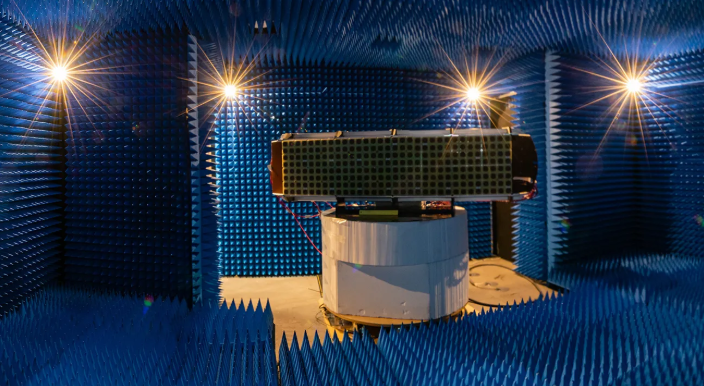
At the heart of this system is a record-setting modular phased-array antenna—spanning over three square meters and integrating 2,048 active elements. Mounted on a hydrogen-powered, zero-emission unmanned aircraft operating at 65,000 feet, the system delivers high-capacity 5G connectivity and ISR support across a 100-mile diameter. With throughput exceeding 100 Gbps, it replicates the performance of hundreds of terrestrial cell towers—without requiring any ground infrastructure.
The platform sustains missions for up to nine days, with advanced thermal stabilization ensuring reliability in stratospheric conditions. A Fibonacci spiral tiling pattern enhances spectrum reuse efficiency by approximately 15%, optimizing multi-beam operations.
Operational Alignment with Army ISR Priorities
This capability directly supports the Army’s modernization objectives, including:
Infrastructure-independent operations: Enables ISR and mission command in denied, remote, or contested environments.
Dynamic beam steering: Provides real-time coverage over maneuvering units, maritime formations, and dispersed tactical elements.
Multi-mission adaptability: Supports radar sensing, electronic warfare, and tactical communications waveforms.
Modular architecture: Tailors to mission profiles, altitudes, and payload configurations.
Strategic Relevance to Army 2025 and Beyond
The system aligns with key Army initiatives:
Multi-Domain Sensing System (MDSS): Enhances deep sensing and long-range targeting capabilities.
Persistent ISR: Offers theater-level surveillance and communications without reliance on satellites or terrestrial assets.
Arctic and Indo-Pacific Operations: Provides resilient connectivity and sensing in high-latitude and maritime environments where conventional platforms are degraded.
Rapid Deployment: Complements Army Prepositioned Stocks (APS) modernization by enabling forward ISR and C2 layers with minimal logistical footprint.
Immediate Efficacy for a Dynamic Battlefield
This system is ready for integration and experimentation by:
Army ISR Task Force – driving persistent sensing and deep targeting capabilities.
U.S. Army Space and Missile Defense Command (SMDC) – advancing high-altitude ISR and comms platforms.
U.S. Army Special Operations Command (USASOC) – supporting agile, infrastructure-independent operations.
U.S. Northern Command (USNORTHCOM) – enhancing Arctic domain awareness and homeland defense.
Persistent Connectivity and ISR Superiority from the Stratosphere
Cambridge Consultants, a Capgemini company, in collaboration with World Mobile Stratospheric (WMS), introduces a transformational airborne communications and sensing capability designed to meet the demands of modern ISR and mission command operations.
At the heart of this system is a record-setting modular phased-array antenna—spanning over three square meters and integrating 2,048 active elements. Mounted on a hydrogen-powered, zero-emission unmanned aircraft operating at 65,000 feet, the system delivers high-capacity 5G connectivity and ISR support across a 100-mile diameter. With throughput exceeding 100 Gbps, it replicates the performance of hundreds of terrestrial cell towers—without requiring any ground infrastructure.
The platform sustains missions for up to nine days, with advanced thermal stabilization ensuring reliability in stratospheric conditions. A Fibonacci spiral tiling pattern enhances spectrum reuse efficiency by approximately 15%, optimizing multi-beam operations.
Operational Alignment with Army ISR Priorities
This capability directly supports the Army’s modernization objectives, including:
Infrastructure-independent operations: Enables ISR and mission command in denied, remote, or contested environments.
Dynamic beam steering: Provides real-time coverage over maneuvering units, maritime formations, and dispersed tactical elements.
Multi-mission adaptability: Supports radar sensing, electronic warfare, and tactical communications waveforms.
Modular architecture: Tailors to mission profiles, altitudes, and payload configurations.
Strategic Relevance to Army 2025 and Beyond
The system aligns with key Army initiatives:
Multi-Domain Sensing System (MDSS): Enhances deep sensing and long-range targeting capabilities.
Persistent ISR: Offers theater-level surveillance and communications without reliance on satellites or terrestrial assets.
Arctic and Indo-Pacific Operations: Provides resilient connectivity and sensing in high-latitude and maritime environments where conventional platforms are degraded.
Rapid Deployment: Complements Army Prepositioned Stocks (APS) modernization by enabling forward ISR and C2 layers with minimal logistical footprint.
Immediate Efficacy for a Dynamic Battlefield
This system is ready for integration and experimentation by:
Army ISR Task Force – driving persistent sensing and deep targeting capabilities.
U.S. Army Space and Missile Defense Command (SMDC) – advancing high-altitude ISR and comms platforms.
U.S. Army Special Operations Command (USASOC) – supporting agile, infrastructure-independent operations.
U.S. Northern Command (USNORTHCOM) – enhancing Arctic domain awareness and homeland defense.
 |
 |